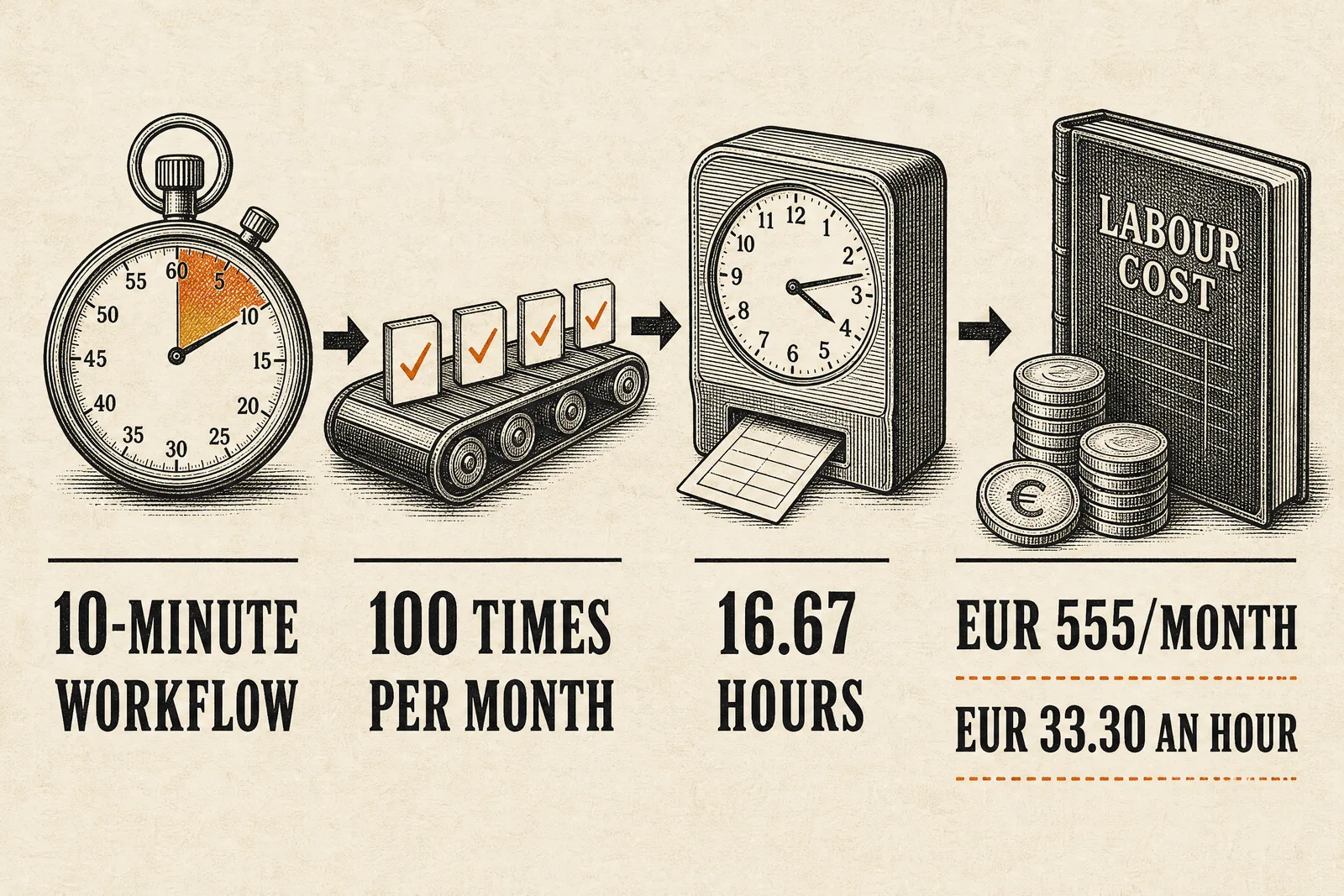
At EUR 33.30 an hour, a 10-minute workflow performed 100 times per month consumes 16.67 hours and represents EUR 555/month in labour cost. Business process automation earns its place when it removes that kind of repeatable drag without creating a fresh queue of mistakes to clean up.
The short version
- Start with frequent handoffs that follow clear rules and move structured data.
- Put lead routing, reminders, invoice-administration handoffs, onboarding and CRM hygiene at the top of the list.
- Keep a named person responsible for exceptions before a workflow goes live.
- Leave hiring and employee-performance decisions with people who can genuinely challenge the output.
The trouble starts in ordinary moments: a Friday lead sits in an inbox, an account manager retypes a signed deal into a CRM, or an invoice waits because someone must copy details between systems. Each task feels too small to fix alone. Together, they turn capable staff into a human bridge between tools. Research on process standardisation describes standardised processes as essential to automation-related digital transformation.
This guide will help you rank business process automation candidates by payback, spot the two risky lookalikes, and decide what should stay human.
Business process automation starts with a suitability score
Repetition alone is a poor reason to automate. A task can happen often and still require interpretation, missing context, or a conversation that changes the next step. Those processes make costly first projects because every unusual case becomes a workaround.
Use a simple score before discussing tools. A strong candidate has a clear trigger, structured input, an agreed rule, an error that someone can reverse, and a named owner for exceptions. This protects the operator from buying a clever flow for a process nobody has actually agreed.
| Test | What a strong answer sounds like | Warning sign |
|---|---|---|
| Trigger | "A form is submitted" | "Someone notices it needs doing" |
| Data | Required fields arrive in known places | Details live in calls, chats or memory |
| Rule | The next action follows a written condition | Staff decide differently each time |
| Recovery | An owner can correct an error quickly | One error changes a consequential outcome |
| Ownership | One person handles exceptions | Everyone assumes somebody else will |
Process complexity limits standardisation. Evidence from 255 process-management experts found that extra standardisation effort does not necessarily overcome that constraint. Do not try to force a tangled client handover into a rigid flow just because it appears on a weekly checklist.
Picture a recruiting firm receiving a completed vacancy brief. If every brief contains a client, role, location, budget range and owner, the handoff can create the CRM record, alert the owner, and log missing fields for review. If each brief arrives as a different voice note with unstated trade-offs, first define the brief. That is process design, not a software problem.
This distinction matters for rule-based automation versus AI agents. Use a fixed workflow when the rule is known. Reserve AI assistance for work where it can draft, classify, or prepare material for a person to assess.
Start with the handoffs that pay back first
The best early work removes clerical movement around a decision, rather than automating the decision itself. Business automation should make the responsible person faster and better informed. It should not hide a handoff until a client asks why nothing happened.
Start with these candidates, provided they pass the suitability score:
- Lead routing: assign a new enquiry by service, territory, availability, or named account owner; acknowledge receipt; and surface incomplete submissions.
- Appointment reminders: send agreed reminders, record replies, and alert a coordinator when a booking needs attention.
- Invoice-administration handoffs: move approved invoice details into the next system and flag missing purchase-order information for a finance owner.
- Standardised onboarding: create the internal checklist after a signed agreement, collect required inputs, and show the owner what remains.
- CRM hygiene: create records from known sources, update agreed fields, and open a review task when records conflict.
Payback is easy to see when volume meets a short, repeatable task. A 15-minute workflow performed 100 times per month represents EUR 832.50/month in labour cost at the EU-services average hourly labour cost in 2024. The point is not to treat every saved minute as cash in the bank. It is to reveal the recurring work that currently prevents someone from following up, preparing, or resolving an exception.
For a consulting firm, lead routing is often the cleanest first test. A web enquiry can enter a defined form, assign to the appropriate partner, create a CRM record, and notify the person who owns the response. The partner still decides whether the work fits. The workflow simply stops the lead from waiting in an inbox over a weekend.
CRM work deserves attention because the starting point is often weaker than leaders assume. Small EU enterprises used CRM software at a rate of 24.69% in 2025. Small EU enterprises used business-intelligence software at a rate of 11% in 2025. A clean, reliable record of who asked for what comes before a useful report about pipeline performance.
For client delivery, automated onboarding for agencies offers a useful pattern. The work begins after a commercial decision is complete: collect the agreed inputs, assign the internal owner, and make gaps visible. That keeps client judgment with the team while removing the copying that follows a signed agreement.
Two tempting processes to leave alone
Some of the most tempting automation ideas sit closest to people's livelihoods. They promise consistency, faster screening, and cleaner management data. They also create consequences that a workflow cannot responsibly own.
The first is hiring decisions. AI can help organise applications or prepare material for a recruiter, but it should not make the final reject-or-progress decision. The ICO made almost 300 recommendations to providers and developers after recruitment-AI audit work, and all were accepted or partially accepted. It identified considerable room for improvement in fair and minimised processing, transparency, and bias controls.
The workable boundary is clear: automate administration around recruitment, such as acknowledgement messages, interview scheduling, and a complete audit trail. Keep the assessment and decision with trained people who can explain their reasoning. That boundary gives candidates a real reviewer rather than a polished-looking automatic answer.
The second is employee-performance or pay decisions. ICO guidance says solely automated decisions with legal or similarly significant effects are restricted under Article 22 of UK GDPR. It gives automatically changing pay based on monitored productivity as an example of such a decision.
Meaningful human review means more than putting a manager's name at the bottom of a result. ICO guidance says the reviewer needs authority and competence to challenge a system's output rather than rubber-stamp it. A manager who can only approve an automated score has not supplied meaningful review.
This is also where generative tools need a narrow role. NIST identifies confabulation as a generative-AI risk and says it is a natural result of how generative models produce outputs. Let an assistant prepare a draft performance summary from approved information; do not let it determine someone's rating, pay, or employment outcome.
Personal data raises the cost of casual experimentation. Relevant GDPR infringements can attract administrative fines of up to EUR 20 million or 4% of worldwide annual turnover. Before any workflow moves candidate, employee, or client information, decide which data it needs, who can access it, and how an owner corrects errors.
Where EsperaStudio fits
A backlog of small frustrations usually hides several different processes, and the first idea on the list is rarely the best build. We start with a EUR 500 automation audit: a written diagnostic, rather than a sales call, that identifies the handoffs, data quality, exceptions, and owner in your actual workflow. We credit that fee toward the build if you go ahead.
We would inspect the point where your team rekeys information, waits for approval, or loses sight of a customer request. Then we would separate the safe administrative steps from the judgment your staff should retain. This avoids automating a broken handoff at speed.
We run each system on infrastructure you own, hosted inside the EU, so operational data does not sit inside a third-party workflow tool and nothing is billed per task. We work as an ongoing monthly partnership, so the system stays maintained as your tools and processes change.
When automation is not worth it
Business process automation is the wrong first move when the team has not agreed what the process is. If every project manager sends a client update in a different format because each client needs a genuinely different conversation, documenting the variation may help more than building a flow.
Pause when the volume is low, the process will disappear soon, or nobody will own exceptions. A one-off migration or a temporary workaround may cost less to complete manually than to specify, test, monitor, and maintain. The right decision can be to leave the task alone.
It also does not suit a business that expects an unattended system to replace accountable judgment. A workflow can route an unusual request to the right person. It cannot create a responsible owner where none exists.
Use this test with your leadership team: can someone write the trigger, inputs, rule, exception owner, and recovery action in plain language? If the answer is no, spend the next week observing the work. The notes will expose the missing agreement that no workflow automation software can invent.
A marketing team with a constantly changing offer may need a lighter first step. Map the route from campaign response to sales follow-up, then automate only the stable part. For another practical example, see this guide to connecting a CRM to automated client reports.
Frequently asked questions
What business process automation should I automate first?
Start with a frequent handoff that has structured data, a written rule, reversible errors, and one exception owner. Lead routing, appointment reminders, invoice administration, onboarding, and CRM hygiene often fit that shape. Choose one workflow where staff can explain each step without relying on memory or private messages.
How should an ai automation agency choose a first workflow?
An ai automation agency should first inspect the work around the decision, rather than promise to automate the decision itself. Ask where information enters, who needs it next, what rule governs the handoff, and who resolves edge cases. A written process map makes the first build testable and easier to improve.
Can ai workflow automation make hiring decisions?
AI workflow automation can prepare administrative work around hiring, such as acknowledgements, scheduling, and application organisation. It should not make the final hiring decision. Recruitment involves fairness, data protection, and bias controls, while meaningful review requires a competent person with authority to challenge the output.
Does a marketing automation agency need workflow automation software?
A marketing automation agency needs a clear operating process before choosing workflow automation software. Compare tools only after you know the trigger, data, exception path, and owner. A low monthly price does not compensate for unclear rules, missing fields, or a workflow nobody monitors after launch.
Sources
- Hourly labour costs ranged from €10.6 in Bulgaria to €55.2 in Luxembourg in 2024 — Eurostat
- Conceptualizing Business Process Standardization: A Review and Synthesis — Springer
- Digital economy and society statistics - enterprises — Eurostat
- Digitalisation in Europe: 2025 enterprise statistics — Eurostat
- Thinking of using AI to assist recruitment? Our key data protection considerations — Information Commissioner's Office
- What do we need to do if we use monitoring tools that use solely automated processes? — Information Commissioner's Office
- Artificial Intelligence Risk Management Framework: Generative Artificial Intelligence Profile — National Institute of Standards and Technology
- Enforcement and sanctions — European Commission