A weekly leak of 5 hours at the EU average hourly labour cost of €34.90 has an illustrative annual labour-cost equivalent of €9,074. Your marketing automation audit starts by catching those hours while they are still hiding in inboxes, spreadsheets, and Friday-afternoon follow-ups. Guessing which task hurts most usually protects the loudest complaint, rather than the most expensive habit.
The short version
- Follow one live process for a week, from trigger to completed outcome.
- Record active work, rework, waiting, hand-offs, and the systems touched.
- Turn the log into a written decision before choosing an automation platform or AI tool.
- Keep personal-data handling and platform usage in the same record as the time cost.
Manual work becomes invisible because each person sees only their own small move. A coordinator copies a lead into a CRM. An account manager chases missing details. Someone corrects a field after a client notices it. In 2025, 17.00% of small EU enterprises used at least one AI technology, yet adoption alone does not identify the process that deserves attention first.
By the end, you will be able to write a marketing automation audit that names the process, its weekly cost, its risks, and the next decision.
Run a marketing automation audit in a week
Start with a process that crosses a team boundary and happens often enough to observe. Lead handover, client onboarding, campaign reporting, and content approval all qualify when people move information between tools. Pick one outcome, such as “a qualified lead reaches the sales owner with complete details,” then follow every step until that outcome occurs.
A useful audit records the work as it happens, rather than asking people to reconstruct a typical week from memory. Give each participant a simple log and ask for the trigger, the action, the minutes spent, the next owner, the tool used, and what caused a repeat. This captures the spreadsheet re-keying habit that never appears in a meeting agenda.
| Moment in the process | Write down | Evidence to keep |
|---|---|---|
| Trigger arrives | Source and time received | Original email, form, or message |
| Someone acts | Action and active minutes | Updated record or sent message |
| Work waits | Next owner and reason | Timestamp or hand-off note |
| Work repeats | What changed and why | Corrected record or client reply |
Use one row for every touch, including the moments when nobody acts. Waiting does not create labour cost in the same way as active work, yet it can expose a process that leaves a fresh enquiry unanswered until Monday. Active minutes show the direct burden; rework shows whether the current process produces work twice.
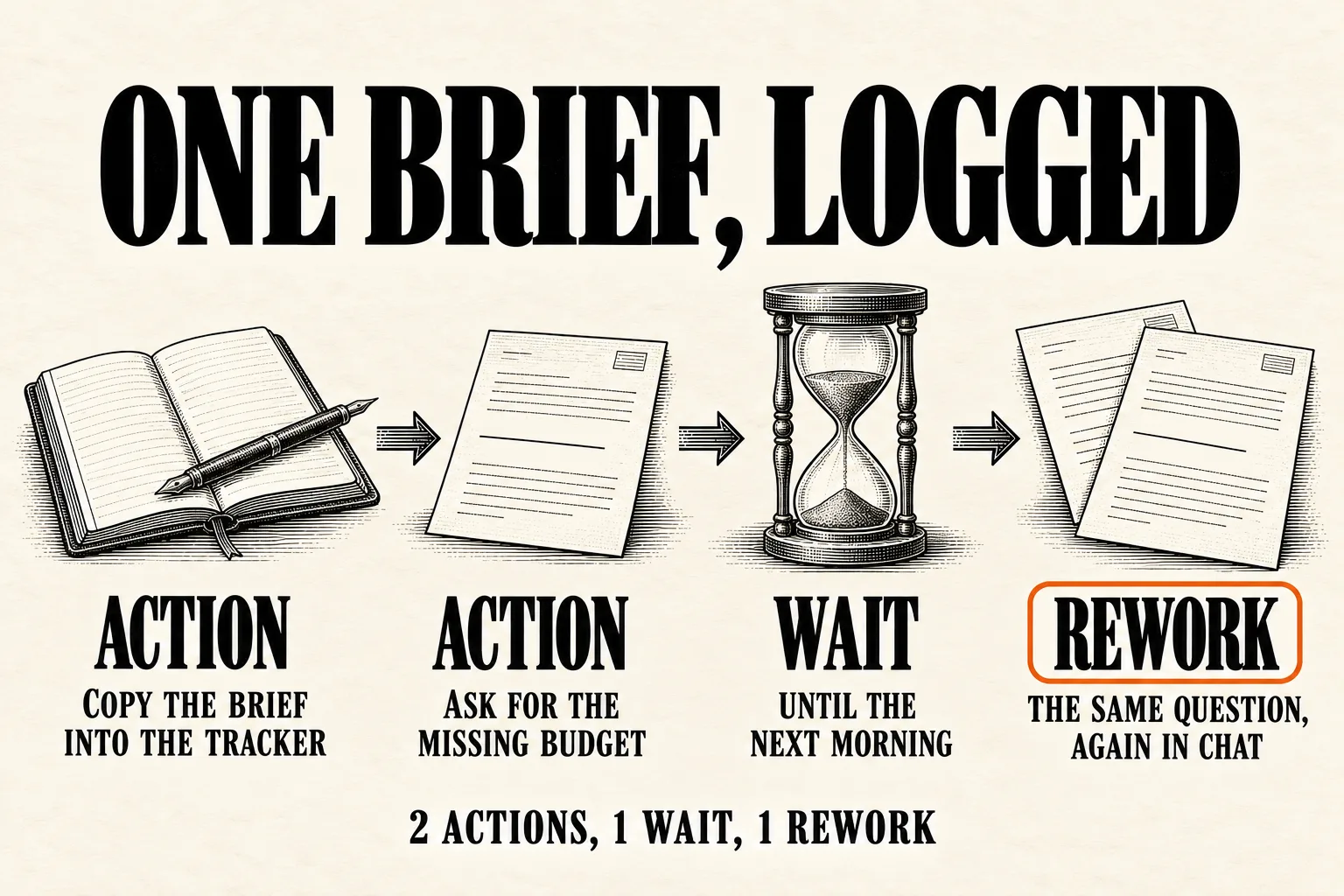
Imagine an agency receiving a campaign brief on Thursday. A client-services coordinator copies details from email into a tracker, then asks for a missing budget field. The paid-media lead opens the tracker the next morning and asks the same question in chat. The log identifies two separate actions, one wait, and one rework event. That is a stronger starting point than “we should automate briefs.”
For a process worth deeper attention, compare the result with the criteria in our guide to what to automate first. If onboarding creates the leak, map the specific hand-offs before borrowing ideas from this client onboarding workflow.
Turn the log into a decision
Your marketing automation audit needs a written scorecard, not a pile of timings. Total the active minutes by role for the week. Mark the rework that came from missing, conflicting, or late information. Then separate a workflow that follows stable rules from one that needs judgement, since the choice between rules and an agent changes the design.
The EU average hourly labour cost was €34.90 in 2025. A weekly leak of 25 hours at that rate has an illustrative annual labour-cost equivalent of €45,370. Use these figures as a reference point, then replace them with your own role costs if you have them.
| Decision area | What your written finding should say |
|---|---|
| Time | Which role performs the work and how many active minutes the process consumes each week |
| Rework | The repeat action, what triggered it, and the record that proves it happened |
| Delay | Where ownership changes and what waits for a reply or approval |
| Data | Which personal data moves between people or systems |
| Usage | Which events could create platform credits or task charges |
Platform usage belongs in the scorecard because consumption can change the operating cost. Make states that most module actions use one credit, while some scenario runs can use from a few credits to thousands of credits. Ask vendors to model the actual events from your log, rather than a neat demo flow.
Data handling also belongs beside the time calculation. Employee business email addresses and business telephone numbers can be personal data. Under the GDPR, a controller using a processor must use processors that provide sufficient guarantees and must govern processing through a contract or other legal act with specified terms.
Medium EU enterprises used at least one AI technology at a rate of 30.36% in 2025. That figure does not tell you whether agentic automation fits your process. A dependable hand-off with fixed fields may call for rules; an exception-heavy task may justify testing an agent after the evidence is clear. Our comparison of agentic AI and rule-based automation explains that distinction.
Where EsperaStudio fits
A time log often reveals that the apparent tool problem is actually an unclear owner, an incomplete input, or a risky data hand-off. The first step with us is a EUR 500 automation audit, delivered as a written diagnostic rather than a sales call. We credit that fee toward the build if you go ahead.
We look at the live process in your situation: the trigger, the records that change, the people who intervene, and the exceptions that create rework. We then write down what should remain a human decision, what can run as a rule, and where an agent could earn its place. That gives you a decision you can examine before build work begins.
We run every system on infrastructure you own, hosted inside the EU. Your operational data never sits inside a third party's workflow tool, and nothing is billed per task. We stay involved monthly so the system can change as your tools and process change.
When this is not worth it
Pause the project when the process changes every time it runs. A week of evidence may show that the team still needs to define the service, the approval rules, or the information clients must provide. Write that finding down and fix the process first.
A marketing automation audit also has limited value when the task is rare, has little consequence when delayed, and has no repeatable trigger. Keep a manual checklist for now. The audit can return later when the work becomes regular enough to observe.
Choose a specialist product where its standard workflow already matches your needs and your team can run it comfortably. An automation business should not build custom connections merely to duplicate a feature you already own. The decision should reduce operational friction, rather than create a system that needs constant supervision.
Frequently asked questions
Do I need marketing automation consulting before buying an automation platform?
Marketing automation consulting helps when you cannot state which process creates the loss, who owns each hand-off, or what data the workflow will touch. Start by logging the live process for a week. If the record shows stable steps and repeatable inputs, you can assess platforms with a clearer brief and fewer assumptions.
Can agentic automation fix a messy marketing process?
Agentic automation can help with tasks that need interpretation, but it cannot supply a missing owner or a reliable source record. First document the exceptions and the decisions people make. If the same judgement recurs with clear boundaries, test an agent on that narrow step and review its output before expanding its role.
How do I choose ai automation software after an audit?
Choose ai automation software against the evidence in your scorecard: process trigger, weekly active work, exceptions, data involved, and expected usage. Ask how the system handles failures and changing inputs. A tool that looks cheap in a short demonstration may create a different cost pattern when every real event runs through it.
Sources
- Eurostat labour-cost statistics — Eurostat
- Eurostat enterprise artificial-intelligence statistics — Eurostat
- Make pricing — Make
- Application of the GDPR — European Commission
- General Data Protection Regulation (GDPR) — EUR-Lex